Understand scar revision, the options to discuss with a qualified clinician and what to confirm before planning a visit to Shiraz.
Key points
- Discuss your individual suitability, alternatives and risks with the treating clinician.
- Ask for written preparation and recovery instructions, including your medicines and follow-up.
- Confirm the healthcare facility, full costs and arrangements before booking travel.
On this page
- First, What Is Scar Revision Surgery?
- WHY SCAR REVISION SURGERY?
- How Is Scar Removal Done in Iran?
- Different Types of Scars
- Hypertrophic and Keloid Scars
- Surface Irregularities
- Burn Scar Contractures
- 1) Surgical Procedures
- 2) Non-Surgical Procedures
- Recovery for Scar Removal Surgery
- Post-Operative Cares AFTER SCAR REVISION
- A practical point for your care
- Planning treatment in Shiraz
- Sources
You don’t have to live with the scar mark you’ve got on your body for some traumatic reasons or the like. Our plastic surgeons with many years of experience and training can tailor the best course of surgery for you to wipe away that annoying mark forever!
Having Experienced a Failed Plastic Surgery,
Pakistani Girl Chooses Iran for a Perfect Revision
Swiss Patient Trusts Iran for
His Cosmetic Surgery Among All Destinations
A Smooth Medical Trip to Iran
for an Amazing Transformation
Australian Lady Saves Money Having
Successful Plastic Surgeries in Iran
Croatian Girl’s Careful Research Led Her
to Iran for an Amazing Plastic Surgery
A Medical Trip to Iran Is Worth It as You Enjoy
Both Great Surgery Results and Low Prices
Haven’t decided yet? Let us help you, it’s free
In a situation where people usually dig deep into their pockets to pay for a missing tooth or scar mark, affordable treatment is a great blessing. That’s why countries with weaker currencies but the same quality of healthcare come up as favorable destinations for many.
If you’re considering Iran as your medical tourism destination but haven’t got enough information about the procedure and what it would be like to get it done in Iran, this article provides you with all you need to know in this respect.
First, What Is Scar Revision Surgery?
Scars are clear signs of old wounds and injuries after they have been improved and healed. They are expected everywhere on the skin.
Scar revision surgery is a plastic surgery that reduces the effect of remaining scars caused by past wounds and injuries and tries to make it blend with the whole texture.
The scar removal surgery adopts different approaches to relieve this problem and enhance the improvement of the scars regarding their unattractive appearance.
WHY SCAR REVISION SURGERY?
Although all people seek out competent surgeons to prevent trace of scarring after their surgery in the first place, some scars still remain visible that is a source of concern for individuals.
Healed wounds also might be noticeable scars that disfigure the appearance of the individual.
The appearance of the scars might diminish as the time elapses. But the improvement process of scars seems to be lumbering.
Scars and their visible protrusions are deeply attached to the individual’s self-worth and profoundly tied to people’s self-esteem in social activities. That’s why people opt for treatment to erase their scars.
Depending on the type and degree of scarring, different treatments might be considered. Most of the time scar surgery is selected to lessen the unattractive facets and to reduce unappealing sights. It might be noteworthy that all the scars don’t need surgery.
How Is Scar Removal Done in Iran?
Scar excision, Z-plasty, and skin grafting are among the surgical procedures mainly used by Iranian doctors. They all will be elaborated in section “scar removal treatment options”.
In general, the treatment may aim at reducing the size of a scar, correcting the raised scars, smoothing the surface, or making a scar less visible. Whatever the purpose, the surgeon may go with a different technique.
The cause of the scars as well as their nature contributes to the selection of different surgical or non-surgical approaches. Before considering the techniques, let us have a look at different types of scars.
Different Types of Scars
There are different kinds of scars each requiring a different type of surgery, which are listed below:
Hypertrophic and Keloid Scars
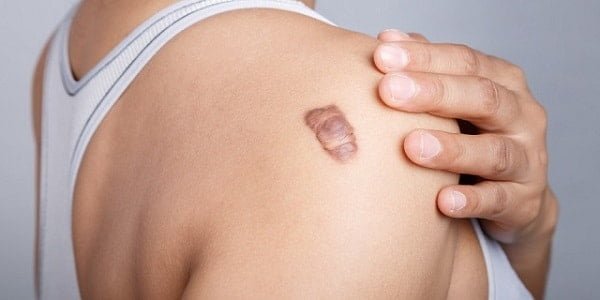
These scars are itchy ones with thick scar clusters that are mostly clear on the edges of the wound or incision. As regards to their color and appearance, they seem to be red and darker than the skin texture.
The cause of these scars is collagen that is produced after the wound has recovered.
Keloids are mostly seen on breastbone, earlobes, and on the shoulders. But the occurrence of such scars is not limited to these parts alone.
Dark-skinned people are among the firsts to have such scars and the chance of one developing such scars are high.
Surface Irregularities
These include acne scars and scars caused by past minor surgeries and surgical incision. They can be cosmetically recovered and healed. Physical discomfort and function impairment are not caused by such scars.
Burn Scar Contractures
Another category of scars is “scar contractures”. They are a result of burns or injuries bringing about extensive skin loss and scars in which the edges of the skin are pulled together during the healing process. They sometimes limit the movements of the crossing joints in fingers, elbows, etc. when the wound is located on these parts.
1) Surgical Procedures
This procedure is beneficial for those who have sunken scars, hypertrophic scars, and keloids. In this surgery, the doctor usually applies local anesthesia. Then, the scar tissue is cut out and layers of one or two tiny stitches are applied to close the wound.
Burn scar contractures and large scarring resulted from an injury or trauma can be treated with this approach.
In this procedure, the doctor applies either local or general anesthesia. Then, the incision is made and the damaged skin is replaced with a skin taken from another area of the patient. The implanted skin is called a skin graft or flap. It’s consisted of the whole dermal tissue with its blood supply.
There is a treatment known as Z-plasty. It is a surgical technique to replace old scars and contractures and to make it less noticeable.
In this method, the surgeon makes a Z-shaped incision so that the middle line of “Z” is placed along the scar. The two other lines of Z are then brought together and stitched.
This will help you have a less obvious scar, but the full function of this technique in making the scar disappear may require further or other techniques.
2) Non-Surgical Procedures
As a non-invasive procedure, a laser can do a great job in treating scar marks. In this method, the doctor directs the laser beam to the area which needs to be treated.
The procedure is cheaper than surgical methods. However, not everyone can benefit from this option. Your doctor can determine whether you are an eligible candidate for this procedure.
However, such treatments may fall short of treatment and you’d need a surgical method to get rid of the keloid or depressed scars.
Dermabrasion removes layers of your skin so that all the pimples, scars, and dark spots are erased. People with small or pigmented scar spots can benefit from this non-surgical procedure which rejuvenates the skin in no time.
Recovery for Scar Removal Surgery
Depending on the type of scar, the depth and nature of the wound, it might take weeks or sometimes months before a scar fades and becomes less apparent. But upon recovery, it yields long-lasting results.
Post-Operative Cares AFTER SCAR REVISION
In order to have ideal results and make sure the wound will recover properly, it is necessary to follow the instructions after surgery. These follow-up steps should be taken to ensure the best result:
- Rest: You must get a lot of rest and try to avoid daily activities as much as possible. This doesn’t mean you have to get bed rest.
- Try to have a healthy diet: Add raw fruit and vegetables to your diet and drink enough amount of water.
- Try to walk and resume daily activities gradually.
A practical point for your care
Before an operation, the pre-assessment team should review your health, previous tests and all medicines and supplements. Ask for written instructions on medicines, eating, drinking and aftercare that apply to your planned procedure.[1]
Planning treatment in Shiraz
Ask SanaMedTour about the appropriate specialty, appointment arrangements and practical support for your visit. The treating clinician confirms the diagnosis, treatment options, suitability and follow-up after assessment.
Request an itemised written quote identifying the clinician, facility, tests, treatment, medicines, reviews and any accommodation or transfers included.
Sources
[1] NHS: Preparing for surgery — supports the individual-care planning note above. ↑ Back to text
Editorial adaptation: 25 October 2026. General information for planning and discussion; your clinician’s individual instructions take priority.