Read the practical considerations around botox vs dermal fillers: a comprehensive guide, with individual preparation and recovery decisions confirmed by your treating team.
Key points
- Discuss your individual suitability, alternatives and risks with the treating clinician.
- Ask for written preparation and recovery instructions, including your medicines and follow-up.
- Confirm the healthcare facility, full costs and arrangements before booking travel.
On this page
- What are Botox and dermal fillers?
- Differences between Botox and fillers
- Botox vs dermal fillers procedure
- How Botox works
- Botox vs dermal fillers applications
- How natural are the results?
- How long do the results of Botox vs fillers last?
- Risks and complications of Botox vs fillers
- Popularity
- Dermal fillers Pros
- Dermal fillers cons
- Botox pros
- Botox Cons
- Last word
- A practical point for your care
- Plan your next step
- Sources
No one wants to look old and no one wants to have wrinkles on the face, so people these days do all sorts of things to have a youthful look. Injectables are nowadays very popular in the field of non-surgical cosmetic procedures. And if you have been considering a cosmetic treatments to get rid of wrinkles, you might have found yourself trying to choose between Botox and fillers.
While both of them are delivered via injection and used to treat your facial wrinkles, it would be wrong to think that they are similar. Botox is a muscle relaxer that is used to treat wrinkles caused by muscle movement. Dermal fillers, on the other hand, are injected under the skin to add more volume and make the skin look fuller.
What are Botox and dermal fillers?
Botox is a short name for ‘botulinum toxin’. It is a neurotoxin produced by a bacterium, used in plastic surgery as a muscle relaxer to treat dynamic wrinkles due to its effect on the muscles.
Dermal fillers, on the other hand, are gel-like materials. As the name suggests they are injected under the skin to regain the loss in volume caused by age.
Differences between Botox and fillers
The differences between the 2 procedures prevent us from considering them alternatives for each other. They are different in the way they work and in their application. Even the results they provide are different. Here is what you need to know about Botox vs fillers:
Botox vs dermal fillers procedure
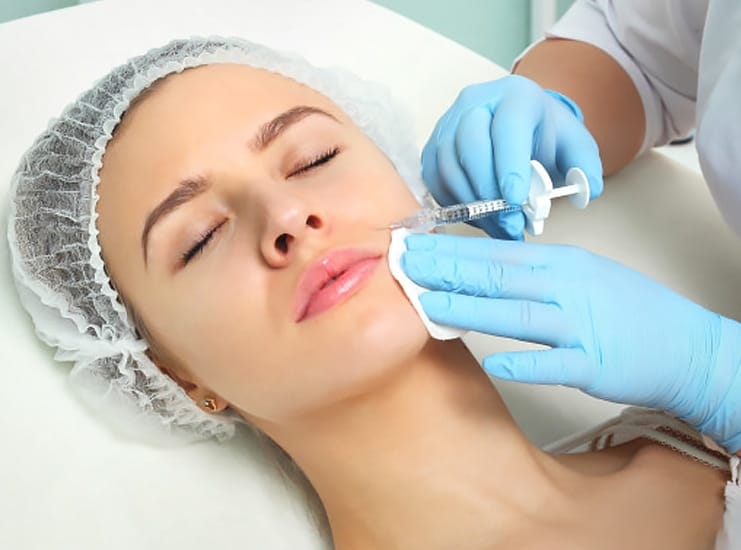
Both Botox and dermal fillers injections are simple outpatient procedures usually performed without anesthesia and sometimes with local anesthesia. Botox and dermal fillers are finely injected into the target area using a syringe.
How Botox works
After injecting Botox into the skin, it starts to block the nerve signals from the targeted muscle. Blocking the signals paralyzes the muscle and freezes it. After the muscle is paralyzed the wrinkles are reduced or even completely disappear in some cases.
Botox vs dermal fillers applications
Due to the effect of Botox on the muscles, it is generally used to treat the dynamic wrinkles also known as expression lines. This includes the treatment of the creases on the forehead, the line between the eyes and those wrinkles under the eyes or at the corners of the eyes (craw’s feet). It can be also used to treat wrinkles caused by facial expressions such as smiling.
Dermal fillers are used to treat the static wrinkles caused by the loss of skin’s elasticity. This means that they can be used to treat wrinkles around the mouth and cheeks. Dermal fillers are also used to make lips look fuller. They are even used to enhance the symmetry of facial features.
How natural are the results?
Well, it depends. Whether you will have a natural look or not depends on many factors like the quantity of the injectables used and the doctor’s experience. It is important that you choose a well-trained and experienced doctor for your procedure because both filler and Botox injection are delicate procedures that need great expertise to produce natural results. Make sure to discuss with the doctor and tell him what you want and expect from the surgery.
How long do the results of Botox vs fillers last?
There are a few types of fillers that are considered semi-permanent. These fillers are polyalkylimide, polylactic acid, and polymethylmethacrylate microspheres (PMMA), which are used for medium-to-deep folds, furrows, and wrinkles.
Risks and complications of Botox vs fillers
Botox, in general, is considered a very safe treatment. We can say that almost anyone can have a Botox. This, of course, does not mean that there are no possible side effects. Some patients may experience a headache on the first day and there might be a risk of bruising in the injection site.
Even though dermal fillers can cause more side effects than Botox, it is still considered a safe treatment. It is very rare to suffer from severe side effects and in case the patient develops one of them, it usually disappears after a week or two. The possible side effects may include bruising in the injection site and some sores and redness.
Since the allergic reaction is considered a possible side effect of the dermal fillers, it is recommended to have an allergy test beforehand. Smokers are advised to avoid getting dermal fillers.
Popularity
In the past few years, the popularity of injectables has been rising constantly. People seem to prefer non-invasive procedures over surgeries. In 2018 alone there were over 10 million non-surgical treatments throughout the world.
However, when it comes to comparing Botox vs dermal fillers, Botox seems to be the winner. The difference in numbers is huge now but dermal fillers are gaining popularity very quickly.
Dermal fillers Pros
- The results appear almost instantly.
- There is no recovery time in dermal fillers, which means you can return to your everyday activity a few hours after the procedure.
- The procedure is not painful, which means you will not need to take any pain killers.
- If you do not like the results it can be reversed easily.
Dermal fillers cons
- You might have some side effects such as bruising, itching, and nausea.
- In rare cases, the filler might shift (migrate) to surrounding areas.
Botox pros
- The results of the Botox will appear quickly. They usually appear after a couple of days after the procedure.
- Botox can help patients with chronic migraines. Some countries have approved the use of Botox to reduce migraines.
- Some patients reported that Botox injections helped them to reduce excessive sweating.
Botox Cons
- Some patients may have an allergic reaction to Botox.
- Bruising is a common side effect after Botox injection.
Last word
While Botox and dermal fillers are popular skin rejuvenating procedures, they may not be always good alternatives to surgery. It is important to keep your expectations realistic and consult with your surgeon about what you have in mind and what results you expect to achieve. Our consultants are also available to help you with any questions you have about Botox and dermal fillers.
A practical point for your care
Before an operation, the pre-assessment team should review your health, previous tests and all medicines and supplements. Ask for written instructions on medicines, eating, drinking and aftercare that apply to your planned procedure.[1]
Plan your next step
Read the patient travel guides · Contact SanaMedTour
Sources
[1] NHS: Preparing for surgery — supports the individual-care planning note above. ↑ Back to text
Editorial adaptation: 25 October 2026. General information for planning and discussion; your clinician’s individual instructions take priority.